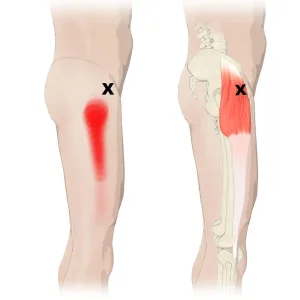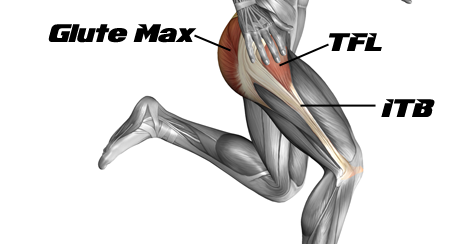
When people think of hip or lower back pain, they often blame a “tight hip flexor,” a disc bulge, or even arthritis. But one small muscle is frequently overlooked—the Tensor Fasciae Latae, or TFL.
At Centre of Health Ivanhoe Physiotherapy & Acupuncture, we commonly find that an overactive TFL contributes to persistent hip pain, lower back pain, ITB discomfort, and even knee problems. While the TFL isn’t always the primary cause of pain, it often becomes part of a dysfunctional movement pattern that can keep symptoms lingering long after the initial injury has settled.
Fortunately, with a thorough assessment and targeted treatment—including motor point acupuncture and physiotherapy—we can often help restore more efficient movement and reduce unnecessary muscle tension.
What Is the TFL?
The Tensor Fasciae Latae is a relatively small muscle located on the outside of your hip, just below the front of the pelvis.
It works together with the gluteal muscles and connects into the iliotibial band (ITB), helping to:
- Stabilise the pelvis while walking and running
- Assist with hip flexion
- Move the leg out to the side (hip abduction)
- Internally rotate the hip
- Help control balance during single-leg activities
Although it is designed to assist movement, the TFL is not meant to do all the work.
When the TFL Becomes Overworked
One of the most common patterns we see is an overactive TFL compensating for weaker or poorly functioning gluteal muscles.
This can happen after:
- Lower back pain
- Hip injuries
- Knee pain
- Pregnancy
- Prolonged sitting
- Previous surgery
- Reduced physical activity
When the gluteus medius or gluteus maximus are not activating efficiently, the TFL often steps in to compensate.
Initially, this helps the body keep moving.
Over time, however, the muscle can become tight, overworked and sensitive, contributing to ongoing pain.
Signs Your TFL May Be Involved
An irritated or overactive TFL can contribute to symptoms such as:
- Pain on the outside or front of the hip
- Tightness that stretching never seems to improve
- Lower back discomfort
- Pain when lying on one side
- ITB tightness
- Pain during walking, running or climbing stairs
- Ongoing discomfort despite strengthening exercises
Many people spend months stretching the TFL without lasting relief because the real issue isn’t simply tightness—it’s that the muscle is working harder than it should.
Why We Look at the Whole Kinetic Chain
Rather than treating the TFL in isolation, we assess why it has become overactive in the first place.
Often we find contributing factors such as:
- Weak gluteal muscles
- Reduced hip mobility
- Altered pelvic control
- Lumbar spine stiffness
- Foot or ankle mechanics
- Changes in walking or running technique
Addressing these factors is often the key to achieving long-term improvement.
How Motor Point Acupuncture Can Help
Motor point acupuncture is a modern acupuncture technique based on anatomy and neurophysiology.
A motor point is the location where a motor nerve enters a muscle. By carefully stimulating these points, we aim to influence muscle function and help restore more balanced movement patterns.
When treating an overactive TFL, motor point acupuncture may help:
- Reduce excessive muscle guarding
- Improve muscle relaxation
- Allow neighbouring muscles, such as the gluteals, to activate more effectively
- Make rehabilitation exercises more comfortable
- Improve overall movement quality
The goal isn’t simply to “release” one muscle. Instead, we use motor point acupuncture as part of a broader rehabilitation program that restores balance throughout the kinetic chain.
Combining Physiotherapy and Acupuncture
At Centre of Health Ivanhoe, motor point acupuncture is rarely used on its own.
Following a detailed assessment, treatment may also include:
- Individualised strengthening exercises
- Gluteal retraining
- Manual therapy
- Hip mobility exercises
- Core stability training
- Movement retraining for walking, running or lifting
By combining these approaches, we aim to address both the symptoms and the underlying movement dysfunction contributing to persistent pain.
Could Your TFL Be Contributing to Your Pain?
If you’ve been struggling with stubborn hip pain, recurring lower back pain, ITB tightness or discomfort that just doesn’t seem to resolve, it may be worth assessing whether your TFL is doing more work than it should.
At Centre of Health Ivanhoe Physiotherapy & Acupuncture, we combine evidence-based physiotherapy with motor point acupuncture to assess how your body moves as a whole, not just where it hurts.
A comprehensive assessment allows us to identify the muscles that are overworking, those that need strengthening, and the movement patterns that may be contributing to ongoing pain.
If you’re ready to move more comfortably and understand what’s driving your symptoms, we’d love to help you take the next step toward recovery.